The impact of oil price fluctuations on the exchange rate of the Iraqi dinar: an econometric study for the period (2004–2025)
- Authors
-
-
اسلام محمد محمود
جامعة الانبار- كلية الادارة والاقتصاد
Author
-
- Keywords:
- Oil price volatility، exchange rate، GARCH models، VAR ، ARIMA.
- Abstract
-
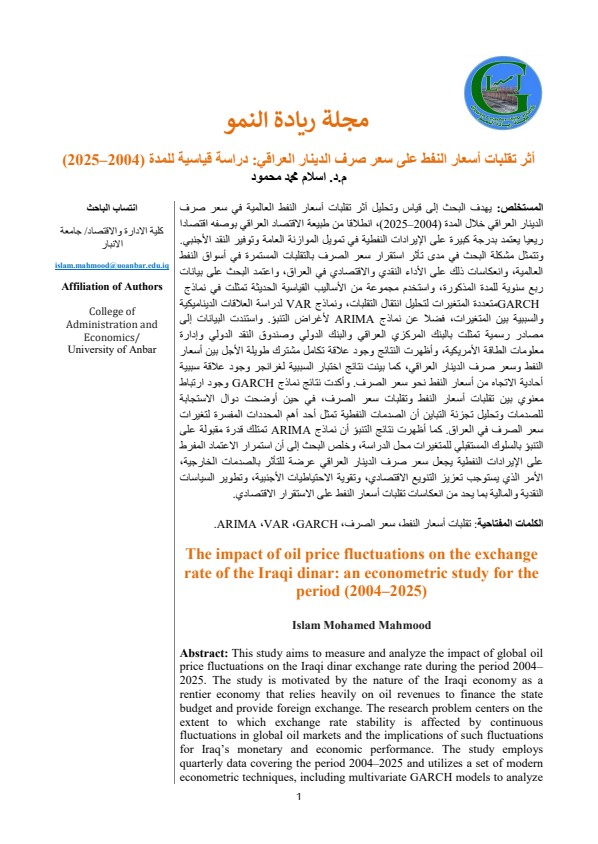
This study aims to measure and analyze the impact of global oil price fluctuations on the Iraqi dinar exchange rate during the period 2004–2025. The study is motivated by the nature of the Iraqi economy as a rentier economy that relies heavily on oil revenues to finance the state budget and provide foreign exchange. The research problem centers on the extent to which exchange rate stability is affected by continuous fluctuations in global oil markets and the implications of such fluctuations for Iraq’s monetary and economic performance. The study employs quarterly data covering the period 2004–2025 and utilizes a set of modern econometric techniques, including multivariate GARCH models to analyze volatility transmission, Vector Autoregression (VAR) models to examine dynamic and causal relationships among variables, and ARIMA models for forecasting purposes. The data were obtained from official sources, namely the Central Bank of Iraq, the World Bank, the International Monetary Fund, and the U.S. Energy Information Administration. The empirical results reveal the existence of a long-run cointegration relationship between oil prices and the Iraqi dinar exchange rate. Furthermore, the Granger causality test indicates a unidirectional causal relationship running from oil prices to the exchange rate. The findings of the GARCH models confirm a significant relationship between oil price volatility and exchange rate volatility. In addition, impulse response functions and variance decomposition analysis show that oil price shocks represent one of the most important determinants explaining exchange rate fluctuations in Iraq. The forecasting results also demonstrate that ARIMA models possess an acceptable ability to predict the future behavior of the variables under study. The study concludes that the continued excessive dependence on oil revenues makes the Iraqi dinar exchange rate highly vulnerable to external shocks. Therefore, enhancing economic diversification, strengthening foreign exchange reserves, and developing monetary and fiscal policies are essential to mitigate the adverse effects of oil price fluctuations on economic stability.
- Downloads
-
Download data is not yet available.
- Cover Image
-
- Downloads
- Published
- 2026-07-02
- Section
- Economy
- License
-
Copyright (c) 2026 Growth Leadership

This work is licensed under a Creative Commons Attribution 4.0 International License.
This is an open-access article distributed under the terms of the Creative Commons Attribution 4.0 International License (CC BY 4.0), which permits unrestricted use, distribution, and reproduction in any medium, provided the original work is properly cited. Authors retain the copyright and full publishing rights without restrictions.

How to Cite
Most read articles by the same author(s)
- اسلام محمد محمود, Dynamics of the Relationship Between Oil Price Fluctuations and Iraqi Financial Markets: An Econometric Study Using the VECM Model for the Period (2000–2025) , Growth Leadership Journal: Vol. 2 No. 2 (2026): Issue 2