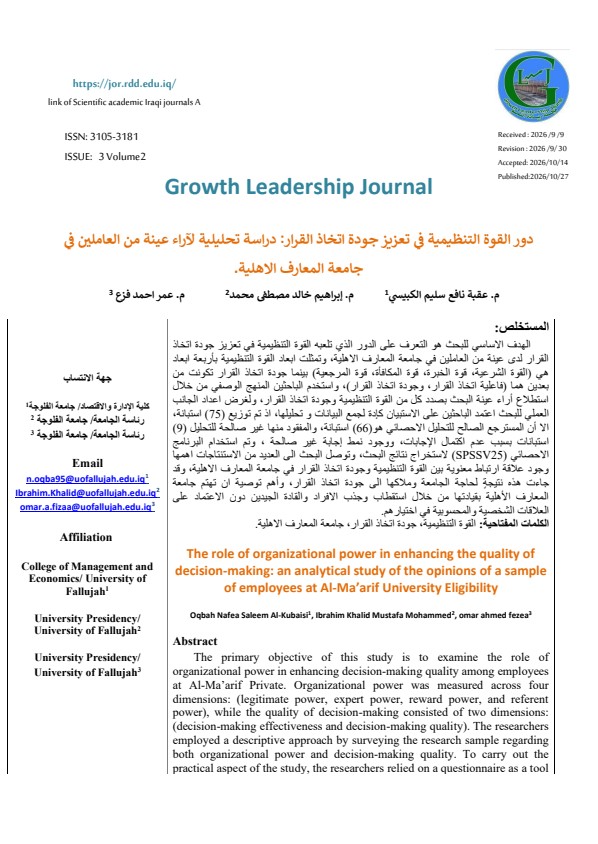
The role of organizational power in enhancing the quality of decision-making: an analytical study of the opinions of a sample of employees at Al-Ma’arif University Eligibility
- Keywords:
- Organizational power, quality of decision-making, Al-Ma'arif Private University
- Abstract
-
The primary objective of this study is to identify the role that organizational
power plays in enhancing the quality of decision-making among a sample of
employees at Al-Ma’arif Private University. Organizational power was
measured through four dimensions: (legitimate power, expert power, reward
power, reference power), while decision-making quality consisted of two
dimensions: (decision-making effectiveness and decision-making quality). The
researchers employed a descriptive approach by surveying the research sample
regarding both organizational power and decision-making quality, For the
practical aspect of the study, the researchers relied on a questionnaire as a tool
for data collection and analysis. A total of 75 questionnaires were distributed;
however, only 66 were valid for statistical analysis, while 9 were invalid and
excluded from the analysis. The statistical software SPSS V25 was used to
analyze the research results. The study reached several conclusions, the most
important of which is the existence of a statistically significant correlation
between organizational power and the quality of decision-making at Al-Ma’arif
Private University. This result stems from the university and its leadership’s
need for high-quality decision-making. The most important recommendation is
that Al-Ma’arif Al-Ahliya University focus on its leadership by recruiting and
attracting qualified individuals and leaders without relying on personal
connections or favoritism in their selection
- Downloads
-
Download data is not yet available.
- Cover Image
-
- Downloads
- Published
- 2026-10-27
- Section
- Business Administration
- License
-
Copyright (c) 2026 Oqbah Nafea Saleem (Author)

This work is licensed under a Creative Commons Attribution 4.0 International License.
This is an open-access article distributed under the terms of the Creative Commons Attribution 4.0 International License (CC BY 4.0), which permits unrestricted use, distribution, and reproduction in any medium, provided the original work is properly cited. Authors retain the copyright and full publishing rights without restrictions.
