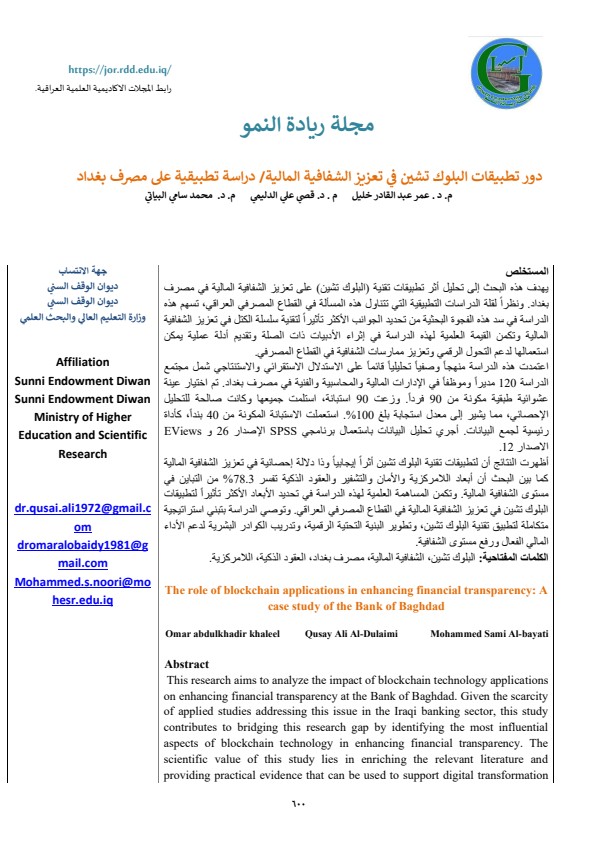
The role of blockchain applications in enhancing financial transparency: A case study of the Bank of Baghdad
- Authors
-
-
دكتور عمر العبيدي
ٍSunni Endowment Dewan
Author
-
قصي الدليمي
Author
-
محمد البياتي
Ministry of Higher Education
Author
-
- Keywords:
- Blockchain, Financial Transparency, Bank of Baghdad
- Abstract
-
Abstract:
This research aims to explore the role of blockchain technology applications in enhancing financial transparency at Bank of Baghdad by analyzing their impact on financial disclosure, internal control, and the quality of financial reports. The research is a descriptive-analytical study that employs an inductive-deductive approach to reach its conclusions.
The research population included all bank employees, including managers and staff in the financial, accounting, and technical departments. The study sample consisted of 90 individuals selected using stratified random sampling. A questionnaire was used as the primary data collection tool, and the data were analyzed using SPSS version 26 and EViews version 12. The research concluded that there is a statistically significant positive correlation between the application of blockchain technology and the level of financial transparency at Bank of Baghdad. The results also showed that three key dimensions of blockchain technology—decentralization, security and encryption, and smart contracts—explain 78.3% of the variance in financial transparency levels, according to the multiple regression model. The research recommends that Bank of Baghdad adopt a clear strategy for implementing blockchain technology in its financial operations, develop its digital infrastructure, and train its employees in its use.
- Downloads
-
Download data is not yet available.
- Cover Image
-
- Downloads
- Published
- 2026-08-27
- Section
- Financial and Banking Sciences
- License
-
Copyright (c) 2026 م.د. عمر عبد القادر العبيدي، م.د. قصي علي ذياب الدليمي، م.د. محمد سامي نوري زياد البياتي (المؤلف)

This work is licensed under a Creative Commons Attribution 4.0 International License.
This is an open-access article distributed under the terms of the Creative Commons Attribution 4.0 International License (CC BY 4.0), which permits unrestricted use, distribution, and reproduction in any medium, provided the original work is properly cited. Authors retain the copyright and full publishing rights without restrictions.
